# Innovation Requirement: Universal Adaptive Contour Forming Machine for Metal Sheet Customization
## Problem Statement
The automotive modification industry, custom bike builders, fabrication workshops, appliance manufacturers, and prototype development companies face a common challenge:
Every unique metal shape requires a dedicated mold, die, or tooling setup.
Traditional manufacturing methods involve:
* Expensive die manufacturing
* Long setup times
* High tooling costs
* Storage of multiple molds
* Limited flexibility for custom jobs
* Economically unviable low-volume production
For example, when a car modifier needs a custom fender, dashboard panel, door contour, bike tank cover, or decorative metal component, a dedicated mold must be created before production begins.
This increases both development time and cost.
---
## Proposed Innovation
### Universal Adaptive Contour Forming Machine
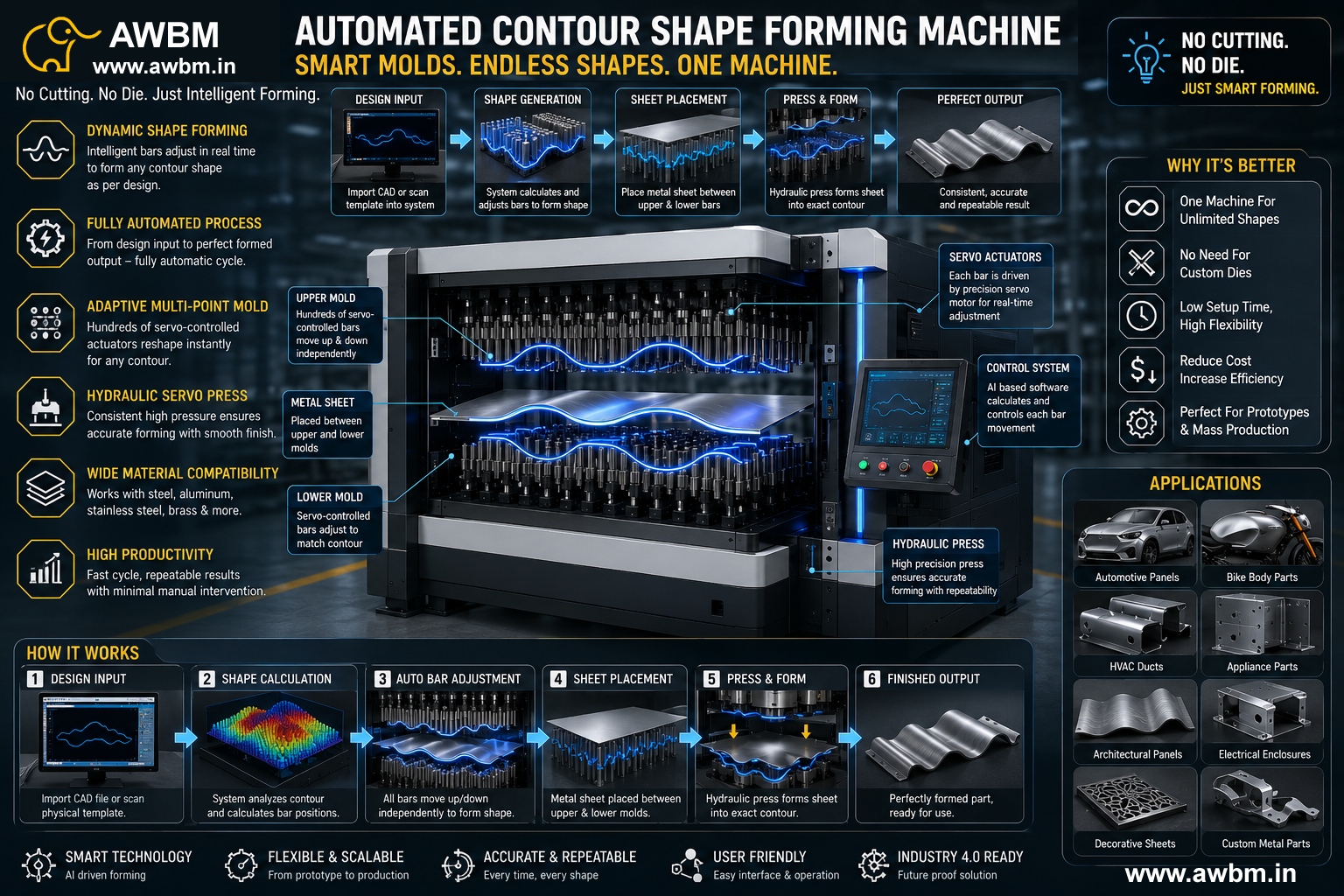
A smart metal-forming machine capable of automatically creating any contour shape without requiring dedicated molds.
The concept is inspired by a contour gauge shape duplicator but scaled into an industrial automated machine.
Instead of fixed molds, the machine contains:
### Upper Adaptive Mold
Hundreds or thousands of independently movable pins/bars arranged in a grid.
### Lower Adaptive Mold
A matching grid of servo-controlled pins/bars positioned opposite the upper mold.
When a design is entered into the system:
1. CAD file is imported.
2. Software converts the contour into pin coordinates.
3. Each upper and lower bar automatically moves to a specific height.
4. Together they create a temporary mold matching the desired shape.
5. Metal sheet is placed between both adaptive surfaces.
6. Hydraulic/servo press applies force.
7. Sheet permanently forms into the required contour.
8. System resets for the next design.
No dedicated die is required.
---
## Working Principle
### Step 1 – Design Input
User imports:
* CAD file
* 3D scan
* DXF
* STEP
* STL
* Physical template scan
### Step 2 – Shape Conversion
Software analyzes:
* Curvature
* Surface profile
* Height variation
* Bend requirements
### Step 3 – Adaptive Mold Generation
AI/Control software calculates position of every bar.
Example:
If machine contains:
* 2,500 upper bars
* 2,500 lower bars
Then all 5,000 bars automatically reposition themselves to create the required shape.
### Step 4 – Sheet Loading
Metal sheet is inserted between adaptive molds.
Supported materials:
* Mild steel
* Stainless steel
* Aluminum
* Brass
* Copper
* Composite sheets
### Step 5 – Forming
Hydraulic or servo press applies pressure.
Adaptive bars transfer the contour into the sheet.
### Step 6 – Output
Finished customized component is produced.
System becomes ready for next design.
---
## Key Innovation Areas
### Adaptive Pin Technology
Independent servo-controlled bars.
### AI Shape Translation Engine
Converts CAD geometry into pin coordinates.
### Real-Time Mold Reconfiguration
Automatic setup within minutes.
### Smart Pressure Control
Material-specific forming parameters.
### Design Library
Store and recall thousands of designs.
### Industry 4.0 Integration
Cloud-based monitoring and analytics.
---
## Potential Applications
### Automotive
* Fender modification
* Bonnet contours
* Door panels
* Interior trims
* Body kits
### Motorcycle Industry
* Fuel tank panels
* Side covers
* Mudguards
* Custom fairings
### Aerospace
* Lightweight panels
* Prototype components
### Architecture
* Decorative metal facades
* Custom wall panels
### Appliances
* Washing machine panels
* Refrigerator parts
### Furniture
* Designer metal products
### Prototyping Industry
* Rapid manufacturing
---
## Expected Benefits
### Cost Reduction
Eliminates need for dedicated molds.
### Faster Production
Setup time reduced from days/weeks to minutes.
### Mass Customization
Every piece can have a different design.
### Lower Investment
One machine replaces hundreds of dies.
### Sustainable Manufacturing
Reduced tooling waste.
### Higher Innovation
Enables small manufacturers to create complex designs.
---
## Prototype Requirement
### Phase 1 – Proof of Concept
Machine Size:
500 mm × 500 mm
Features:
* 100–400 movable bars
* Servo-controlled movement
* Basic CAD import
* Manual sheet loading
* Low-pressure forming
Objective:
Validate adaptive contour generation.
### Phase 2 – Functional Prototype
Machine Size:
1000 mm × 1000 mm
Features:
* 1,000+ adaptive bars
* Automated shape generation
* Hydraulic pressing
* Touchscreen control
Objective:
Create real automotive and bike panels.
### Phase 3 – Commercial Product
Machine Size:
Customizable
Features:
* 5,000–20,000 adaptive bars
* AI-driven contour optimization
* Industrial production capability
* Multi-material support
---
## Seeking Innovators
We are looking for:
* Mechanical Engineers
* Mechatronics Engineers
* Robotics Experts
* Industrial Automation Specialists
* CNC Machine Designers
* Hydraulic System Designers
* AI/Control System Developers
* Manufacturing Startups
* Research Institutions
* Prototype Development Teams
The goal is to develop the world\\\\\\\'s first commercially viable Universal Adaptive Contour Forming Machine capable of transforming digital designs directly into metal sheet contours without dedicated dies or molds.
Status: Concept Seeking Innovators, Technical Partners, Prototype Developers and Investors.


Technical Discussion
No technical queries yet.